
Introduction
Electric vehicles have changed the way people drive. Instead of worrying about fuel prices, drivers now pay attention to battery power, charging time, and driving range.
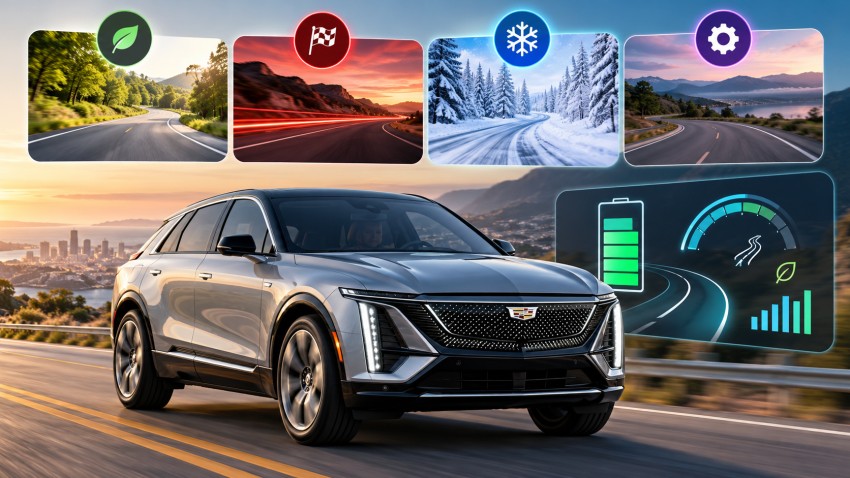
The Cadillac LYRIQ is a luxury electric SUV that combines advanced technology with smooth performance. It offers several driving modes to improve comfort, handling, and control.
However, many owners wonder whether changing these modes affects battery performance.
Cadillac LYRIQ Driving modes can influence energy consumption and real-world range. However, they do not change the battery’s physical capacity.
Tour Mode offers balanced performance for everyday trips. Sport Mode delivers a sharper driving response. Snow/Ice Mode helps manage slippery roads, while My Mode allows personalized settings.
Each mode serves a different purpose. The amount of electricity the vehicle uses depends on how the driver responds to those settings.
This guide explains how the modes work, how they influence battery consumption, and which settings make sense for different driving conditions.
It also covers battery health, regenerative braking, winter range, highway efficiency, and practical ways to get more miles from each charge.
Understanding the Cadillac LYRIQ Battery System
The LYRIQ uses a large lithium-ion battery pack to power its electric motors.
Unlike a gasoline vehicle, it does not need an engine to burn fuel. Instead, electricity flows from the battery to the electric drive system.
The motors turn the wheels and move the SUV.
Battery capacity determines how much electrical energy the vehicle can store.
Manufacturers measure this capacity in kilowatt-hours, or kWh.
The 2026 Cadillac LYRIQ uses a battery with a rated capacity of 102 kWh.
However, battery capacity does not directly tell drivers how far the SUV can travel.
Actual range depends on how efficiently the vehicle uses its stored energy.
For example, an SUV that uses 30 kWh per 100 miles can travel farther than one that uses 40 kWh over the same distance.
This difference becomes important when comparing driving modes.
Battery Capacity vs. Battery Consumption
These terms sound similar, but they describe different things.
Battery capacity is the amount of energy the battery can store.
Battery consumption is the amount of electricity the vehicle uses while driving.
Driving range is the distance the vehicle can travel before it needs another charge.
Changing driving modes does not increase battery capacity.
However, it may change how quickly the SUV consumes its available energy.
Battery Life vs. Battery Health
Battery life can refer to two different things.
The first is how long a charge lasts during a trip.
The second is how well the battery maintains its capacity over several years.
Driving modes may affect short-term energy use.
Long-term battery health depends on many other factors, including temperature, charging habits, battery age, and overall usage.
Understanding this difference helps drivers make better decisions.
What Are the Driving Modes in Cadillac LYRIQ?
The standard LYRIQ offers four main driving modes.
These are Tour, Sport, Snow/Ice, and My Mode.
Each mode changes selected vehicle settings to suit different driving conditions.
The modes can affect accelerator response, steering feel, braking characteristics, and traction management.
However, not every setting directly changes electricity consumption.
The following table explains their main functions.
| Driving Mode | Main Purpose | Possible Effect on Range |
|---|---|---|
| Tour Mode | Comfortable everyday driving | Supports smooth, efficient driving |
| Sport Mode | Responsive acceleration and handling | Aggressive driving may increase consumption |
| Snow/Ice Mode | Better control on slippery roads | Winter conditions often reduce range |
| My Mode | Personalized driving preferences | Depends on settings and driving behavior |
Cadillac does not publish separate EPA range ratings for these four modes.
Actual efficiency depends on the driver’s actions and the surrounding conditions.
1. Tour Mode: The Best Choice for Everyday Efficiency
Tour Mode provides balanced performance for regular driving.
It offers smooth acceleration and comfortable vehicle responses.
Cadillac designed this mode for everyday road conditions.
Drivers can use it for commuting, shopping, highway travel, and longer journeys.
How Tour Mode Works
Tour Mode uses balanced accelerator calibration.
This makes it easier to increase speed gradually.
The vehicle also provides comfortable handling characteristics.
Drivers can maintain a steady pace without constantly adjusting the accelerator.
These characteristics may support efficient driving habits.
Does Tour Mode Save Battery Power?
Tour Mode can help drivers conserve energy when they accelerate smoothly and maintain reasonable speeds.
However, it is not a guaranteed battery-saving mode.
A driver who accelerates aggressively can still consume significant electricity.
The mode provides a comfortable starting point, but the driver controls actual power demand.
When Should You Use Tour Mode?
Tour Mode makes sense for:
- Daily commuting
- Highway travel
- City driving
- Family trips
- Long-distance journeys
- General battery efficiency
For most owners, Tour Mode is the most practical everyday setting.
2. Sport Mode: Does Better Performance Use More Battery?
Sport Mode makes the LYRIQ feel more responsive.
It provides more immediate torque response and changes steering characteristics.
This setting can make acceleration feel stronger and more engaging.
However, performance-focused driving may increase electricity consumption.
How Sport Mode Changes Acceleration
Electric motors can deliver torque almost immediately.
Sport Mode changes how the vehicle responds when the driver presses the accelerator.
The SUV may accelerate more quickly with the same initial pedal movement.
This can make merging and passing feel more responsive.
However, faster acceleration requires more power.
Why Sport Mode Can Reduce Range
The battery supplies energy whenever the electric motors produce power.
Strong acceleration increases power demand.
If a driver repeatedly accelerates hard, the SUV may consume more electricity per mile.
Over a long journey, this can reduce the distance available from a charge.
However, simply selecting Sport Mode does not mean the battery will drain at a fixed higher rate.
A driver who maintains a steady speed may experience similar consumption in Tour and Sport.
Does Sport Mode Damage the Battery?
Normal use of Sport Mode should not damage a healthy battery.
Cadillac designed the vehicle to operate within its supported performance limits.
The battery management system helps control temperature, power delivery, and other operating conditions.
However, repeated high-power driving can generate additional heat and increase battery cycling.
Over many years, operating conditions can influence battery aging.
This does not mean occasional Sport Mode use causes meaningful battery damage.
When Should You Use Sport Mode?
Sport Mode is useful when drivers want:
- More responsive acceleration
- A stronger performance feel
- Engaging steering response
- Confident highway merging
- A sportier driving experience
When maximum range matters, smooth acceleration remains the better choice.
3. Snow/Ice Mode: Does It Reduce Driving Range?
Snow/Ice Mode helps drivers manage slippery roads.
It changes accelerator response to reduce the chance of wheel spin.
This can improve control when driving on snow or ice.
However, the mode does not exist primarily to save battery power.
How Snow/Ice Mode Works
Slippery surfaces provide less tire grip.
Sudden acceleration can cause wheels to spin.
Snow/Ice Mode softens the vehicle’s response to accelerator input.
This helps drivers apply power more gradually.
The goal is better control.
Why Winter Driving Reduces Range
Many EV owners notice lower driving range during winter.
Several factors contribute to this change.
Cold battery temperatures: Low temperatures can affect battery performance and energy availability.
Cabin heating: Heating the interior requires electricity.
Battery temperature management: The vehicle may use energy to warm the battery.
Snow-covered roads: Snow and slush can increase rolling resistance.
Winter tires: Some winter tires have greater rolling resistance than standard tires.
These factors can reduce efficiency even when the driver uses Tour Mode.
Should You Avoid Snow/Ice Mode to Save Battery?
No.
Safety should always come before a small potential improvement in efficiency.
When roads become slippery, Snow/Ice Mode can help drivers maintain control.
Choose the setting that best matches the road conditions.
Plan extra charging time during cold weather instead of avoiding useful traction features.
4. My Mode: Can Personalized Settings Improve Range?
My Mode allows drivers to customize certain vehicle responses.
It provides more control over how the LYRIQ feels during everyday driving.
Depending on the vehicle’s equipment, drivers can adjust supported settings such as accelerator response, steering feel, braking response, and electric vehicle sound enhancement.
How My Mode Works
Drivers select their preferred characteristics through the vehicle’s controls.
For example, a driver may prefer gentle accelerator response and comfortable steering.
Another driver may want sharper acceleration with a different steering feel.
My Mode allows these preferences to work together.
Can My Mode Save Battery?
A smoother accelerator setting may encourage gradual acceleration.
This can help drivers avoid unnecessary power demand.
However, My Mode is not a dedicated economy mode.
It does not automatically optimize every part of the vehicle for maximum range.
Actual efficiency depends on the selected settings and driving habits.
Best My Mode Settings for Efficient Driving
Drivers who prioritize range may prefer:
- Smooth accelerator response
- Comfortable steering settings
- Predictable braking response
- Gradual acceleration
- Steady driving speeds
The goal is to make efficient driving easier.
No My Mode combination guarantees a specific mileage improvement.
How Driving Modes Affect Electricity Consumption
Cadillac LYRIQ Driving settings influence vehicle behavior rather than changing the battery itself.
Several factors explain why energy consumption can differ between modes.
Accelerator Sensitivity
The accelerator controls how much power the driver requests.
Sport Mode provides a sharper response.
Tour Mode offers a more balanced feel.
A sharper response can encourage stronger acceleration.
However, the driver’s actions remain important.
Electric Motor Power Demand
Electric motors require electricity to produce torque.
Strong acceleration demands more power than gentle acceleration.
Repeated high-power driving can increase energy use.
Steering and Handling
Driving modes may change steering characteristics.
These settings affect vehicle feel and responsiveness.
However, steering adjustments generally have a smaller effect on driving range than speed or acceleration.
Traction Management
Snow/Ice Mode helps control wheel slip.
This can improve stability on difficult surfaces.
Its energy impact depends on road conditions and how the vehicle responds.
Driving Behavior
Two drivers can select the same mode and achieve different efficiency results.
One driver may accelerate gently and maintain steady speeds.
Another may accelerate hard and brake frequently.
Their battery consumption can differ even when they use identical vehicles.
Which LYRIQ Driving Mode Provides the Longest Range?
Tour Mode is generally the best starting point for efficient everyday driving.
It provides balanced accelerator response and comfortable handling.
However, no mode guarantees the longest possible range.
For example, consider two drivers.
The first uses Tour Mode but frequently accelerates hard and travels at high speeds.
The second uses Sport Mode but drives smoothly and maintains moderate speeds.
The second driver may achieve better efficiency.
This happens because actual power demand matters more than the selected mode alone.
The most efficient approach combines a suitable driving mode with careful driving habits.
Official Cadillac LYRIQ Range Figures
Official EPA range estimates help buyers understand what to expect from different vehicle configurations.
For the 2026 model year, Cadillac lists the following figures.
| Vehicle Configuration | EPA-Estimated Range |
|---|---|
| Single-motor RWD | 326 miles |
| Dual-motor AWD with standard 11.5 kW charging equipment | 319 miles |
| Dual-motor AWD with available 19.2 kW charging equipment | 303 miles |
| LYRIQ-V | 285 miles |
These figures apply to specific vehicle configurations.
They do not represent Tour, Sport, Snow/Ice, or My Mode.
Actual range may differ based on equipment, temperature, road conditions, and driving habits.
RWD vs. AWD: Which Uses More Battery?
The LYRIQ offers rear-wheel-drive and all-wheel-drive configurations.
RWD models use a single electric motor.
AWD models use two motors to provide additional traction and performance.
The AWD system can improve acceleration and grip.
However, the extra hardware and different operating characteristics can influence efficiency.
The 2026 RWD version has a higher official range estimate than the standard AWD version.
This does not mean AWD is always inefficient.
The difference depends on vehicle design, equipment, and driving conditions.
Does Selecting Sport Mode Activate AWD?
No.
Driving modes do not change the physical drivetrain installed in the vehicle.
An RWD model remains rear-wheel drive.
An AWD model retains its dual-motor hardware.
Mode selection changes supported driving characteristics rather than converting one drivetrain into another.
How Regenerative Braking Affects Battery Range
Regenerative braking helps electric vehicles recover some energy during deceleration.
In a traditional vehicle, friction brakes convert much of the vehicle’s movement into heat.
An EV can use its electric motor to recover part of that energy.
The motor acts as a generator and sends electricity back to the battery.
This process can improve overall efficiency.
However, regenerative braking cannot recover every unit of energy used during acceleration.
What Is Regen on Demand?
The LYRIQ offers Regen on Demand.
This feature lets drivers control regenerative deceleration through a steering-wheel paddle.
It can help slow the vehicle while recovering some energy.
Drivers should still use the brake pedal whenever necessary.
What Is One-Pedal Driving?
One-Pedal Driving allows drivers to control acceleration and much of their deceleration through the accelerator pedal.
When the driver releases the accelerator, the vehicle can slow using regenerative braking.
This can make stop-and-go traffic easier to manage.
It may also reduce the need to use the brake pedal during normal driving.
Does One-Pedal Driving Increase Range?
One-Pedal Driving can support efficient energy recovery.
However, it does not guarantee more range in every situation.
On an open highway, avoiding unnecessary speed changes may be more efficient than repeatedly slowing and accelerating.
The best approach depends on road conditions.
Important Safety Considerations
Regenerative braking may become limited when the battery is nearly full or temperatures are extremely hot or cold.
Cadillac also advises against using One-Pedal Driving on slippery roads.
Drivers should follow the owner’s manual and use the brake pedal whenever needed.
How Speed Affects LYRIQ Battery Consumption
Vehicle speed has a major effect on EV efficiency.
As speed increases, air resistance becomes stronger.
The electric motors must use more energy to overcome that resistance.
This becomes especially important during highway travel.
City Driving vs. Highway Driving
City driving often includes frequent stops and lower speeds.
Regenerative braking can recover some energy during deceleration.
Highway driving usually involves higher speeds and greater aerodynamic resistance.
As a result, the vehicle may use more electricity per mile at high highway speeds.
However, traffic, temperature, and terrain also influence the comparison.
Why Driving Faster Reduces Range
Imagine driving at a moderate highway speed.
The vehicle uses electricity to overcome air resistance and rolling resistance.
When speed increases, aerodynamic drag rises sharply.
The motor must deliver more power to maintain the higher speed.
This can reduce driving range even in Tour Mode.
Maintaining a reasonable speed is often more useful than repeatedly switching driving modes.
How Weather Affects Battery Performance
Weather can influence electric vehicle range throughout the year.
Cold Weather
Cold temperatures can reduce available battery performance.
Heating the cabin also consumes electricity.
Battery temperature management may create additional energy demand.
Hot Weather
High temperatures can increase air conditioning use.
The battery cooling system may also need more energy.
Strong Winds
Headwinds increase the resistance the vehicle must overcome.
Tailwinds may reduce that resistance.
Rain and Wet Roads
Wet surfaces can increase rolling resistance.
Heavy rain may also require drivers to use climate control and other electrical systems.
Snow and Slush
Snow-covered roads create extra resistance.
Drivers may also need to travel more slowly for safety.
Weather can therefore influence range more than the driving mode itself.
Does Climate Control Affect LYRIQ Battery Life?
Climate control uses electricity from the vehicle’s battery.
Heating and air conditioning can reduce the energy available for driving.
The effect depends on outside temperature, cabin settings, and trip length.
Cabin Heating
Heating requires additional energy during cold weather.
Short winter trips may show higher energy consumption because the vehicle must warm the cabin repeatedly.
Air Conditioning
Cooling the cabin also uses electricity.
The impact can become more noticeable during extreme heat.
Preconditioning
Preconditioning allows drivers to prepare the cabin before departure.
When the vehicle remains connected to a charger, some of the energy needed for heating or cooling can come from the charging source.
This may help preserve driving energy.
Preconditioning does not eliminate climate-control energy use during the trip.
Understanding the LYRIQ Range Estimate
The dashboard displays an estimated remaining driving range.
This number helps drivers plan their journeys.
However, it is not a guaranteed distance.
The estimate can change as driving conditions change.
For example, it may decrease faster during high-speed travel.
It may also adjust after a period of heavy acceleration or cold-weather driving.
Why Does Estimated Range Change After Switching Modes?
A driver may notice the range display changing around the time they select another mode.
However, that does not prove the mode directly changed battery capacity.
The estimate can respond to recent energy consumption and other operating conditions.
A more responsive mode may encourage stronger acceleration.
That increased energy demand can influence the range estimate.
Battery Percentage vs. Estimated Miles
Battery percentage shows the remaining charge relative to the battery’s usable capacity.
Estimated miles predict how far the vehicle may travel using that energy.
These values are related but different.
For example, the same battery percentage may support different distances during city and highway driving.
Drivers should consider both values when planning longer trips.
How to Calculate EV Battery Efficiency
Understanding energy consumption helps drivers compare trips more accurately.
Electric vehicles commonly measure efficiency in kilowatt-hours per 100 miles.
A lower number means the vehicle uses less electricity over the same distance.
Example Calculation
Suppose a vehicle uses 30 kWh to travel 100 miles.
Its consumption is 30 kWh per 100 miles.
Now imagine another trip where the vehicle uses 36 kWh over the same distance.
The second trip uses 20% more electricity.
This difference can reduce the available driving range.
Hypothetical Range Comparison
Consider a vehicle with 100 kWh of usable energy.
The following example shows how consumption affects potential range.
| Energy Consumption | Approximate Range |
|---|---|
| 28 kWh per 100 miles | 357 miles |
| 30 kWh per 100 miles | 333 miles |
| 34 kWh per 100 miles | 294 miles |
| 38 kWh per 100 miles | 263 miles |
| 42 kWh per 100 miles | 238 miles |
These figures are mathematical examples.
They are not official LYRIQ test results or mode-specific range ratings.
Actual usable battery capacity and operating conditions can differ.
The table demonstrates why lower electricity consumption supports greater range.
How to Compare Tour and Sport Mode Fairly
Drivers can conduct simple comparisons to understand their vehicle’s efficiency.
However, a reliable comparison requires similar conditions.
Step 1: Choose a Familiar Route
Select a route with consistent road conditions.
Avoid routes with unpredictable traffic whenever possible.
Step 2: Record Starting Conditions
Write down the battery percentage, outside temperature, and tire pressure.
Also note the number of passengers and the amount of cargo.
Step 3: Drive in Tour Mode
Complete the route using normal, safe driving habits.
Record the trip distance and energy consumption.
Step 4: Repeat in Sport Mode
Use the same route and similar conditions.
Maintain comparable speeds and acceleration.
Step 5: Compare Results
Look at electricity consumption rather than only the estimated remaining range.
Step 6: Repeat the Test
A single trip may produce misleading results.
Repeat the comparison several times to reduce the influence of traffic and weather.
The goal is to understand how mode selection affects normal driving.
Do not perform unsafe acceleration tests on public roads.
Can Driving Modes Affect Long-Term Battery Health?
This question requires a distinction between everyday battery use and long-term battery aging.
Driving modes mainly affect vehicle response.
They do not directly control the battery’s age or guarantee a longer battery lifespan.
However, driving behavior can influence battery operating conditions.
Frequent High-Power Driving
Strong acceleration increases power demand.
Repeated high-power use can create additional heat.
Modern EVs use battery management systems to control operating conditions.
However, frequent exposure to demanding conditions can contribute to battery wear over time.
Battery Temperature
Extreme temperatures can influence battery aging.
The vehicle’s thermal management system helps maintain suitable conditions.
Charging Habits
Charging behavior can also affect long-term battery health.
Cadillac recommends an 80% charge limit for routine daily use, with higher charge levels available when needed for longer trips.
Owners should follow guidance for their specific model year.
Battery Age
All lithium-ion batteries experience gradual aging.
Capacity can decline over time.
The rate depends on several factors, not simply the selected driving mode.
Does Tour Mode Extend Battery Lifespan?
There is no established Cadillac claim that Tour Mode alone extends battery lifespan by a specific amount.
However, smooth driving can reduce unnecessary power demand.
Good charging habits and temperature management remain important for long-term battery care.
How to Maximize Cadillac LYRIQ Driving Range
Drivers can improve efficiency by following practical habits.
1. Use Tour Mode for Daily Travel
Tour Mode provides balanced driving characteristics.
It is a sensible default for most road conditions.
2. Accelerate Gradually
Avoid unnecessary bursts of acceleration.
Smooth power delivery can reduce energy consumption.
3. Maintain Reasonable Highway Speeds
Higher speeds increase aerodynamic drag.
Moderate speeds can help conserve energy.
4. Check Tire Pressure
Underinflated tires can increase rolling resistance.
Use the pressure recommended by Cadillac.
5. Reduce Unnecessary Cargo
Extra weight increases the energy required to accelerate.
Remove items that you do not need.
6. Use Climate Control Efficiently
Choose comfortable but reasonable temperature settings.
Precondition the cabin while plugged in when practical.
7. Plan Charging Stops
Use route-planning tools to locate suitable charging stations.
Allow extra range for weather, traffic, and unexpected delays.
8. Learn Regenerative Braking Features
Understand how Regen on Demand and One-Pedal Driving work.
Use them when conditions allow.
9. Monitor Actual Energy Consumption
Review trip efficiency over time.
This helps identify habits that increase battery usage.
10. Follow Battery Charging Recommendations
Use the recommended daily charging limit.
Adjust the target when you need additional range for a trip.
11. Avoid Unnecessary Speed Changes
Frequent acceleration and braking can waste energy.
Maintain a smooth pace whenever traffic conditions allow.
12. Prioritize Safety
Never choose a driving mode solely to save battery when another setting provides better control.
Best Driving Mode for Different Situations
The following table provides practical suggestions.
| Driving Situation | Recommended Mode | Main Benefit |
|---|---|---|
| Daily commuting | Tour | Smooth and comfortable driving |
| Long highway trips | Tour | Balanced performance |
| Performance-focused driving | Sport | Sharper vehicle response |
| Snow-covered roads | Snow/Ice | Better control of wheel slip |
| Icy roads | Snow/Ice | Gentler accelerator response |
| Personalized driving | My Mode | Customizable vehicle characteristics |
| General range conservation | Tour | Supports relaxed driving habits |
| Mixed city and highway travel | Tour or My Mode | Predictable everyday response |
The best choice depends on road conditions and driver preferences.
Common Misconceptions About LYRIQ Driving Modes
Myth 1: Sport Mode Always Uses More Battery
Sport Mode can encourage stronger acceleration.
However, it does not automatically consume a fixed percentage of extra energy.
Driving habits determine much of the difference.
Myth 2: Tour Mode Guarantees Maximum Range
Tour Mode supports balanced driving.
However, aggressive acceleration and high speeds can still reduce efficiency.
Myth 3: Snow/Ice Mode Causes Winter Range Loss
Winter range loss usually involves several factors.
Cold temperatures, heating demand, and road conditions often matter more than the selected mode.
Myth 4: My Mode Is an Eco Mode
My Mode allows personalization.
It does not provide a guaranteed energy-saving program.
Myth 5: Regenerative Braking Recovers All Energy
Regenerative braking recovers only part of the energy involved in slowing down.
Some energy still becomes heat or other losses.
Myth 6: Switching Modes Changes Battery Capacity
The installed battery remains the same.
Driving modes change vehicle behavior rather than energy storage capacity.
Myth 7: Driving Modes Directly Determine Battery Lifespan
Long-term battery health depends on multiple operating and environmental factors.
Mode selection alone does not determine battery lifespan.
Myth 8: AWD and Sport Mode Are the Same
AWD refers to the vehicle’s drivetrain.
Sport Mode changes selected driving characteristics.
They are not interchangeable.
Frequently Asked Questions
Do Cadillac LYRIQ Driving modes affect battery life and range?
Yes. Different modes can influence energy consumption through accelerator response and driving behavior. However, they do not change battery capacity or directly determine long-term battery health.
Which LYRIQ driving mode offers the best range?
Tour Mode is generally the most practical choice for efficient daily driving. However, speed, acceleration, weather, and road conditions have major effects on actual range.
Does Sport Mode drain the battery faster?
Sport Mode can increase consumption when drivers accelerate aggressively. However, steady driving may produce similar efficiency to Tour Mode.
Is Snow/Ice Mode less efficient?
Snow/Ice Mode focuses on traction. Cold weather, heating, and snowy roads often explain reduced winter efficiency.
Can My Mode save battery power?
A smoother accelerator setting may encourage efficient driving. However, My Mode does not guarantee additional range.
Does Sport Mode damage the LYRIQ battery?
Normal use of Sport Mode should not damage the battery. The vehicle includes systems that manage battery operation.
How does regenerative braking improve range?
Regenerative braking recovers some energy during deceleration and returns it to the battery.
Is One-Pedal Driving better for battery efficiency?
It can help recover energy in suitable conditions. However, it does not guarantee greater efficiency on every trip.
Why does LYRIQ range decrease on highways?
Higher speeds increase air resistance and electrical power demand.
Does cold weather affect battery range?
Yes. Cold temperatures, heating, and road conditions can reduce the distance available from a charge.
Is the RWD LYRIQ more efficient than AWD?
The 2026 RWD configuration has a higher EPA-estimated range than the standard AWD configuration.
Does changing modes affect charging speed?
Driving modes do not directly determine charging speed. Charging performance depends on battery conditions, charging equipment, and other factors.
Can drivers switch modes during a trip?
Cadillac provides controls for selecting available driving modes. Drivers should follow the owner’s manual and make changes safely.
What is the best driving mode for long trips?
Tour Mode is a practical choice because it provides smooth, balanced driving characteristics.
How can owners protect long-term battery health?
Follow Cadillac’s charging recommendations, avoid unnecessary exposure to extreme conditions, and maintain the vehicle properly.
Conclusion
The Cadillac LYRIQ offers several driving modes to improve comfort, performance, and control.
Tour Mode provides balanced everyday driving. Sport Mode offers stronger responsiveness. Snow/Ice Mode helps drivers manage slippery roads, while My Mode supports personalized settings.
Cadillac LYRIQ Driving modes can influence electricity consumption, but they do not change the battery’s physical capacity.
They also do not directly determine how long the battery will last over several years.
Actual driving range depends on acceleration, speed, temperature, road conditions, climate control, and vehicle configuration.
For most drivers, Tour Mode provides a sensible balance between comfort and efficiency.
However, smooth driving habits often matter more than mode selection alone.
By understanding these differences, owners can manage battery consumption, plan longer journeys, and enjoy the LYRIQ’s performance without unnecessary range concerns.
UploadBlog For Tech is a trusted technology blog that shares the latest tech news, product reviews, trending topics, software tips, digital innovations, and helpful guides.